
Helicopter parenting hasn’t vanished—it’s evolved. In 2025 we’re seeing “trailing” parents alongside classic over-involvement. Abroad101’s archive shows recurring themes: contact expectations, visit boundaries, safety, and finances. The latest research links high helicoptering with higher anxiety/depression and lower autonomy. See The Atlantic’s coverage and recent peer‑reviewed studies.

Why this matters now
Recent coverage has spotlighted parents who physically “trail” their kids—renting nearby apartments, shadowing classes, or monitoring abroad terms—an escalation from classic hovering. That raises real questions about student autonomy and program boundaries in overseas contexts (emergency lines, privacy rules, and cultural norms differ).
What our data shows on Abroad101
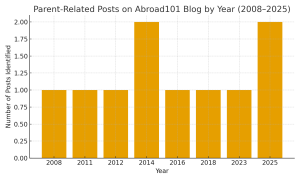
A long arc of parent content
- 2008: A typology of helicopter parents: From Hovering Mentors to Intrusive Rescue Squads
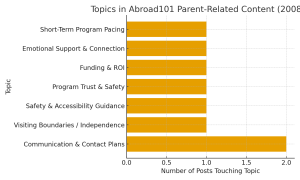
- 2011–2012: Communication and pre‑departure expectations: How to Handle Your Parents While Abroad and Parents: What to Do Before Your Son or Daughter Leaves.
- 2014: Accessibility and safety: Students with Disabilities Studying Abroad.
- 2016: Visiting boundaries and independence: Leave Your Kids (Abroad) Alone.
- 2018: Financing: How Parents Can Solve the Study Abroad Funding Gap.
- 2014–2025: Expectations/mental well‑being: Evaluations & Expectations and recent stress/anxiety guidance.
What students actually write in reviews
Students notice parental involvement. Many appreciate support when they ask for it; others describe overreach that limits independence. A forthcoming text analysis on our 45K+ reviews will quantify how often “parent(s)” are referenced and what topics co‑occur (e.g., safety, housing, finances).
What recent research says (2023–2025)
Multiple studies associate helicopter parenting with higher anxiety and depression and lower autonomy/self‑efficacy. Representative sources: Frontiers in Psychiatry (2024); Frontiers in Psychology (2022); Springer 2024 meta‑analysis; MDPI 2025 meta‑analysis.
The healthy‑involvement framework (for study abroad)
Unhelpful helicoptering includes uninvited staff contact, surprise program drop‑ins, negotiating grades/housing directly, daily multi‑hour check‑ins, and shadowing excursions.
Supportive involvement includes:
- Agree on 1–2 scheduled weekly check‑ins (with emergency exceptions).
- Help with pre‑departure logistics while letting the student lead.
- Encourage use of program resources and on‑site staff.
A 10‑minute Communication Agreement (copy‑paste)
When: 1–2 weeks before departure:
- Cadence: “We’ll do a video call Sundays 6 pm local and message once mid‑week if needed.”
- Channels: “If urgent: call the program’s 24/7 number first, then call/text parents.”
- Boundaries: “Parents won’t contact staff unless student invites or in a documented emergency.”
- Location‑sharing: “Share location during travel days only; turn off for day‑to‑day life.”
- Visit plan: “No surprise visits. If desired, one host‑city visit after mid‑terms.”
- Crisis drill: “Who to call for health, safety, academic issues—program > home university > family.”
For students: quick scripts
- Over‑text: “I’m safe and engaged here. Let’s stick to our Sunday call—if anything urgent comes up I’ll call first, promise.”
- Staff call: “My program asks that I reach out first. I’ll email them now and loop you in if needed.”
- Visit: “A visit after mid‑terms would be amazing. Before then I need to build my own routine.”
For parents: Do / Don’t
- Do: Set the plan, ask about goals, encourage program resources, celebrate small wins, send low‑pressure support.
- Don’t: Phone staff first, negotiate grades/housing, show up unannounced, expect daily debriefs, or manage trip details like a project plan.
Program & university checklist
- Put contact boundaries and crisis escalation in pre‑departure materials; reiterate at orientation.
- Offer a parent webinar on safety, health, comms, and privacy—share slides + FAQ.
- Publish a one‑page parent guide (print‑friendly) with emergency numbers and visit guidance.
- Track parent‑initiated tickets separately to spot hotspots and target communications.
References & further reading
External: The Atlantic (2025) | Frontiers in Psychiatry (2024) | Frontiers in Psychology (2022) | Springer Meta‑analysis (2024) | MDPI Meta‑analysis (2025)
Abroad101 archive: 2008 helicopter parent typologies | 2011 handle parents | 2012 parent prep | 2014 disabilities abroad | 2016 leave your kids (abroad) alone | 2018 funding gap | 2014 expectations